What If We’ve Got the SaaSpocalypse Backwards?
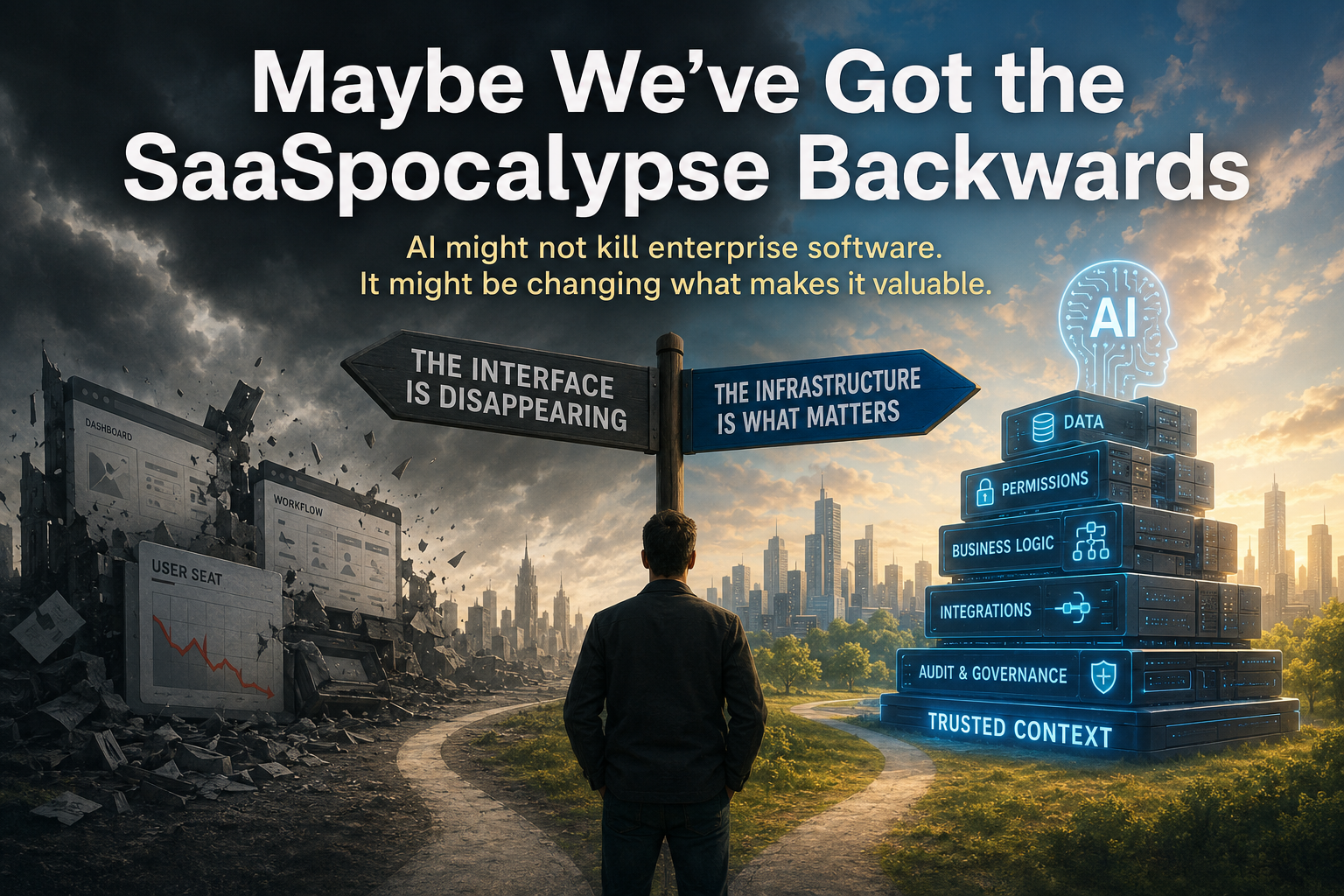
The UI might be shrinking. But AI still needs data, permissions, integrations and business logic underneath it. Perhaps we’ve been looking at the wrong layer.
Software stocks have had a fairly miserable year, with Salesforce, ServiceNow, Workday and plenty of others hammered as the market tries to work out what AI means for traditional software.
The argument makes sense. If AI agents can do things that previously required humans clicking around inside software, perhaps we don’t need as much software. Fewer users. Fewer seats. Eventually, fewer applications.
Hence the SaaSpocalypse.
And there is obviously something in it.
But I’m starting to wonder whether we’ve got part of the argument backwards.
A strange few days in software
Last week Salesforce announced a new agreement with the US Department of Veterans Affairs worth up to $1.6 billion over three years.
Before getting too excited, the “up to” matters.
This isn’t $1.6 billion of guaranteed Salesforce revenue. It’s a one-year agreement with two optional one-year extensions and a $1.6 billion ceiling. If the VA doesn’t like what it gets, it doesn’t have to keep buying.
But the number isn’t actually the interesting bit.
Look at what the VA bought.
Agentforce Public Sector. Agentforce Health. Slack. MuleSoft. Tableau. Data 360.
And look at what they’re trying to do with it: patient triage, benefits verification, contact centre support and scheduling. One of the stated ambitions is to reduce appointment scheduling from an average of 28 days to minutes.
That’s not really an AI deal.
It’s an enterprise software deal with AI running through it.
The SaaSpocalypse argument
The market has spent much of this year worrying that AI is going to eat software.
You can see why that logic appears to make sense.
- Why pay for twenty different applications if an intelligent agent can sit above them?
- Why buy another workflow tool if an AI can create the workflow?
- Why give every employee a software licence if agents are doing an increasing proportion of the work?
I’ve made versions of this argument myself.
A few months ago I wrote about Salesforce’s Headless 360 announcement and the possibility that the traditional interface starts to disappear.
Instead of:
Human → Screen → Application → API → Application
we increasingly get:
Human → Agent → API → Application
The human doesn’t necessarily need to visit the application anymore.
That’s potentially a pretty serious problem if your business model depends on charging humans to use screens.
But there’s another side to it.
The screen might disappear. The system behind it doesn’t.
Agents still need somewhere to work
This is the bit I think we might be underestimating.
An AI agent can be incredibly capable, and still be completely useless inside a large organisation.
Knowing what to do isn’t enough.
It needs access to the right customer data. It needs to know who that customer is. It needs permission to perform an action. It needs access to other systems.
Just as importantly, it also needs to know what it isn’t allowed to do.
Someone needs to decide what happens when it gets something wrong and when to hand off to a ‘real person’.
And preferably, there needs to be some record of what the bloody thing did afterwards.
None of that disappears because the model got smarter.
I’ve spent a fair chunk of my career around Salesforce, MuleSoft and enterprise transformation. The messy bit has rarely been whether the technology can theoretically do something.
It’s everything around it.
The old system nobody wants to touch. Customer records duplicated across five platforms. An integration built eight years ago by someone who left six years ago. A process everyone complains about but nobody actually owns.
Then security gets involved.
Then legal.
Then someone remembers the data lives in another country.
AI doesn’t magically remove any of that.
It might expose just how much of it we’ve been tolerating.
The boring stuff might become the valuable stuff
This connects with something I’ve been thinking about for a while.
I recently wrote that a lot of enterprise complexity exists because software was dumb.
We built forms, workflows, approval processes and endless bits of middleware because computers needed humans to tell them precisely what to do next.
AI changes that.
But if intelligent software can now act autonomously, knowing what it’s allowed to do becomes rather important.
An agent that can reason over a customer problem is useful.
An agent that can access trusted customer data, check permissions, query another system and actually fix the problem is much more useful.
And suddenly some fairly unfashionable bits of enterprise technology matter again.
Data. Integration. Identity. Governance. APIs.
Not exactly the stuff that gets people queueing around the block at an AI conference.
But possibly the stuff that determines whether any of this actually works.
There’s a problem with this argument
If fewer humans are using the software, how do the software companies get paid?
This is where I think the shift away from seats gets interesting.
Salesforce is already doing it.
Agentforce can be bought using Flex Credits, where customers pay for actions performed by agents. Updating a customer record, running a prompt or executing a workflow consumes credits. Salesforce also offers per-conversation pricing and more traditional user licences.
In other words, Salesforce is beginning to charge for work done by software, not just humans accessing software.
That’s quite a change.
For decades SaaS economics have been beautifully simple.
More employees using your product meant more seats, which meant more revenue.
If ten humans and twenty agents can do what thirty humans used to do, that model starts to wobble.
But perhaps the replacement isn’t fewer software revenues.
Perhaps we stop paying primarily for access and start paying for activity.
The interesting metric might eventually be less about how many people logged into Salesforce this month and more about how much work happened through it.
Whether customers actually like that pricing model is another question entirely.
Of course, the plumbing might get commoditised too
There’s another fairly obvious hole in my argument.
What if Salesforce doesn’t own the plumbing either?
Anthropic’s Model Context Protocol, MCP, is designed to standardise how AI systems connect to tools and data. Anthropic has since donated it to the Linux Foundation’s Agentic AI Foundation, which it co-founded with Block and OpenAI. The intention is for MCP to remain open and vendor-neutral.
If agents can connect to Salesforce, SAP, ServiceNow, a home-grown database and whatever else is lying around through open protocols, proprietary integration becomes less defensible.
Jack Dorsey’s new Buzz platform pushes at another part of the same problem.
Buzz puts humans and AI agents into the same conversations, but unlike Slack it is built on Nostr, an open decentralised protocol. Agents get identities, channel memberships and permissions of their own.
So perhaps the chat layer gets commoditised.
Perhaps some of the integration layer does too.
But I think perhaps that’s where this gets interesting.
MCP might make it easier for an agent to call Salesforce.
It doesn’t magically clean fifteen years of customer data, decide which system owns the customer record, work out who can approve a refund or explain why Finance and Sales have completely different definitions of revenue.
The protocol can become a standard. The organisational mess can’t.
At least not yet.
Salesforce has an advantage. It also has baggage.
I’ve been around Salesforce for about 15 years, so I’m conscious of my own bias here.
Salesforce has CRM, Data 360, MuleSoft, Slack, industry clouds and Agentforce.
That’s a lot of useful pieces if enterprise software becomes an environment in which humans and agents both work.
It’s also a lot of products.
Anyone who has worked around large Salesforce estates knows the other side of the story. Complexity. Technical debt. Acquisitions that don’t always fit neatly together. Licensing that requires a spreadsheet and possibly a minor in economics.
Being the incumbent gives Salesforce data, customers and distribution.
It also gives Salesforce fifteen years of accumulated enterprise stuff.
So perhaps the race isn’t simply incumbents versus AI startups.
It’s whether companies like Salesforce and ServiceNow can turn their existing estates into clean environments for agents faster than AI-native companies can learn how enterprise permissions, governance, regulation and legacy systems actually work.
I don’t know who wins that race.
I suspect it will vary enormously by customer.
Which brings us back to the market
I’m reluctant to read too much into a couple of days in the stock market. Markets change their minds considerably faster than enterprise architecture does.
But the last few days have been interesting.
Salesforce jumped roughly 7%, ServiceNow around 8% and Workday around 10% on Monday as money moved back into beaten-up software stocks. At the same time, Nvidia and AMD fell sharply.
It could simply be a rotation.
Software has been smashed. Chips have had an extraordinary run. Investors take profits from one and buy the other.
Nothing more complicated required.
But underneath the share prices, there are some actual numbers worth watching.
Agentforce ARR reached $1.2 billion in Salesforce’s first quarter, up 205% year on year. Combined with Data 360, Salesforce’s AI and data products are approaching $3.4 billion in ARR, although Informatica accounts for part of that.
And the VA isn’t buying an AI experiment.
It’s putting agentic technology into real workflows across one of the largest healthcare systems in America.
That doesn’t prove the SaaSpocalypse is wrong.
But it makes the story a bit less tidy.
Maybe we’re asking the wrong question
Some software companies absolutely will get hurt by AI.
If your product is essentially a nice interface wrapped around a relatively simple task, I’d be nervous.
Seats probably matter less too. If ten people and twenty agents can do what thirty people used to do, charging per human user starts looking increasingly strange.
So I’m not arguing that AI is somehow good news for every SaaS company.
Far from it.
I’m wondering whether we’re looking at the wrong layer.
The interface may become less valuable. The systems underneath it may become more important. And some of those systems may themselves become open standards or commodities.
Which leaves the genuinely difficult stuff.
Your data. Your business rules. Your permissions. Your processes. Your organisational history.
All the messy context that tells an agent not just how to do something, but whether it should be doing it in the first place.
We’ve spent the last couple of years asking:
What will AI replace?
I’m starting to think there’s a more useful question.
What does AI make more valuable?