
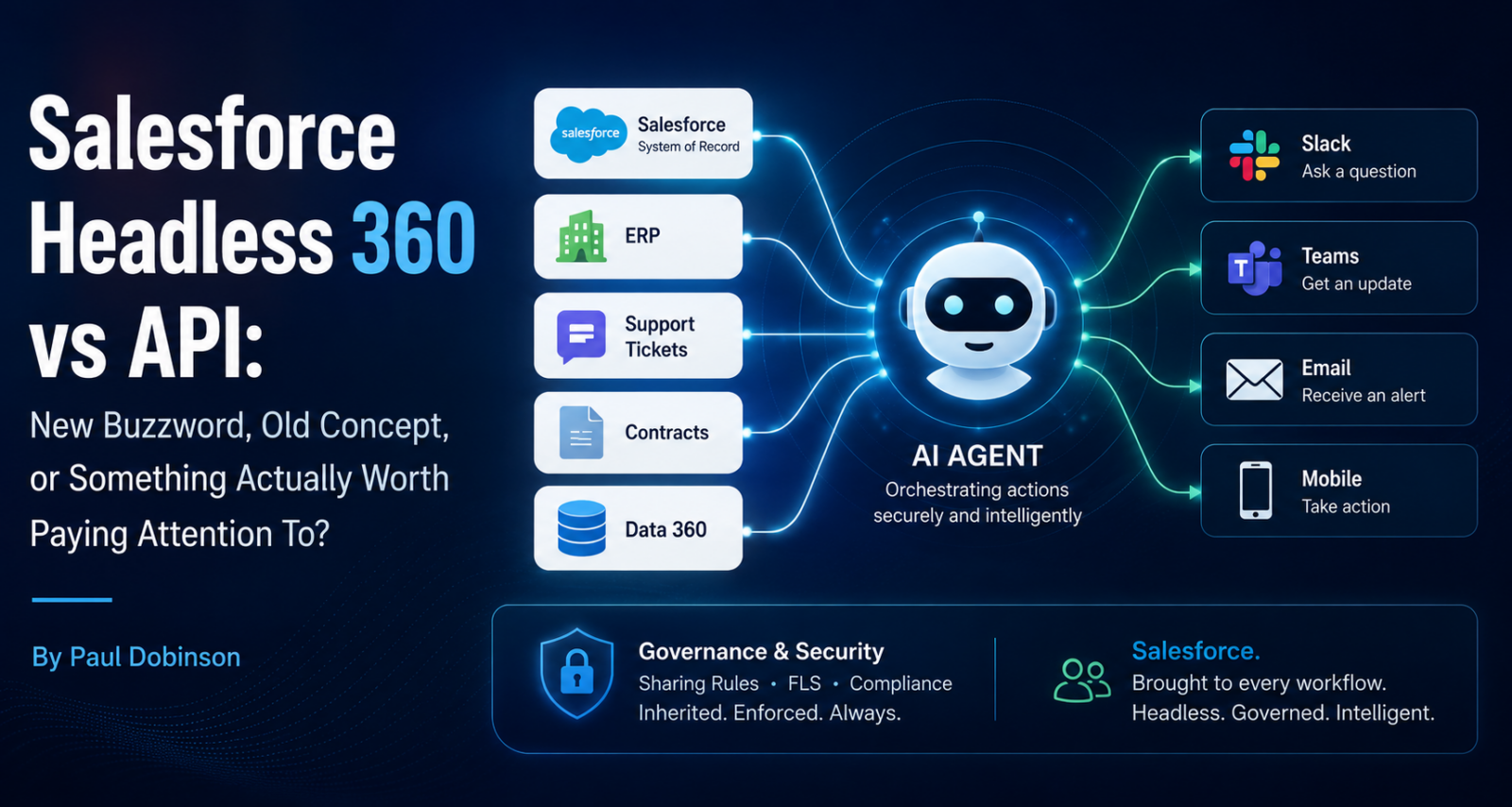
Salesforce Headless 360 vs API: New Buzzword, Old Concept, or Something Actually Worth Paying Attention To?
I was in a customer conversation this week when Salesforce’s “Headless 360” announcement came up. The situation was familiar: a business that had invested seriously in Salesforce but was fighting an adoption battle. Their people were not logging in. Teams were working in their own tools, their own spreadsheets, their own workflows, and Salesforce was becoming a system of record that nobody was actually recording things in.
At the same time, they had been using MuleSoft for years to push data out of Salesforce into third-party applications. Notifications, updates, customer data surfaced in other tools, all flowing out of Salesforce without anyone touching the UI. They had, without ever labelling it as such, already been operating headless for a long time.
So when the Headless 360 announcement landed, they asked me directly: “Is this actually new, or is this just what we already do?”
Mostly the latter. But not entirely. And the gap between those two answers is where the real conversation sits.
FIRST, WHAT DOES “HEADLESS” ACTUALLY MEAN?
“Headless” simply means interacting with a system without using its user interface. No browser. No clicking. Just the underlying data and logic, accessed programmatically.
Salesforce has supported this since it launched its REST API back in 2010. My customer had been living proof of that for years, pulling data out, pushing updates in, surfacing Salesforce information inside the tools their people actually used, all via MuleSoft. Their users were not logging into Salesforce. They were consuming Salesforce data without knowing it, inside whatever application sat in front of them that day.
That is headless. It just was not called that, because it never needed to be. It was simply good integration work. So when Salesforce calls something “Headless 360” in 2026, the honest reaction is that the headless part is not new. What they are wrapping around it is. But to understand why that matters, you need to understand what enterprise integration actually looked like before agents entered the picture, because it was never as simple as the marketing suggests.
API FOR DUMMIES: THE VENDING MACHINE
Think of a single API call like a very precise vending machine. You know exactly which button to press (the endpoint), you put in the right coins (the payload), and you get a specific snack back (the response). Every time. Predictable. Repeatable.
Simple enough. But real enterprise processes are never one vending machine. They are a whole building full of them, and someone has to coordinate which ones get used, in which order, with what data flowing between them. That is where it gets complicated fast.
THE MULESOFT ANSWER: THREE TIERS, NOT A STRAIGHT LINE
When I was working in the MuleSoft world, the answer to that complexity was the three-tier API-led connectivity model. The business logic behind it was sharp and it held up well in practice.
System APIs sat closest to your backend systems, whether that was Salesforce, SAP, your ERP, or your legacy database. Their job was to provide a clean, stable abstraction over whatever was underneath. You built it once, and it spoke Salesforce so nothing else had to.
Process APIs were the business logic layer. Qualifying a lead is not one API call. It might touch Salesforce for account data, your marketing platform for engagement history, your ERP to check whether they are already a customer, and a scoring model to produce a recommendation. The Process API orchestrated all of that into one coherent outcome. Explicitly coded, fully traceable, and every decision auditable.
Experience APIs sat at the top, tailored for the consuming channel. Your mobile app needed different data than your web app. Your B2B partner needed different fields than your internal sales team.
The commercial argument was powerful. Build your Salesforce System API once and every process that needs Salesforce data consumes it. Change Salesforce underneath and you change one place, not twenty scattered integrations. It was not a straight line from coins to snack. It was a deliberately layered architecture where each tier had a clear job, clear ownership, and clear accountability.
My customer this week had done exactly this. Their users were already acting headless. They just never needed to call it that, because it was simply how their systems worked.
SO WHERE DOES THE AGENT FIT?
Here is where it gets interesting. Headless 360 does not really challenge the System API concept. Salesforce is still the system of record and you still need a clean way to access it programmatically.
What it challenges is the Process layer, the business logic and orchestration tier. And that changes the commercial conversation significantly.
Take a concrete example. A customer has a renewal due in 30 days. They also have an open escalation, a breached SLA, and a relationship owner who knows their CFO personally. In a traditional integration architecture, someone coded that scenario explicitly: if renewal is within 30 days and there is an open escalation, route to the senior rep, notify the account owner, pause any automated outreach. Every branch, explicitly scripted. My customer this week had flows like this. Solid, reliable, well-governed, built over years by people who understood the business.
With Agentforce and Headless 360, Salesforce’s argument is that the agent becomes the process layer. It reasons across those signals, decides what actions to take, and executes them using pre-built, governed Salesforce actions as the mechanism. The developer does not script every scenario. The agent works it out.
That is a meaningful shift. Not because headless is new, but because the thing consuming the API is no longer a deterministic process someone coded. It is a reasoning system making judgement calls. And that changes what governance, oversight, and implementation need to look like.
THE REAL BUSINESS INSIGHT: GOVERNANCE THAT TRAVELS WITH THE ACTION
In the traditional API model, governance had to be deliberately built into your integration layer. Service accounts had fixed permissions set at deployment time. If a user’s Salesforce access changed after go-live, through a permission update, a new compliance control, or a sharing rule change, the integration often did not know and did not care. You built that governance layer yourself, and in most real-world programmes it was either done inconsistently or quietly skipped.
When an agent operates inside Salesforce via Headless 360, it inherits the live trust layer. The sharing rules, field-level security, and compliance controls your IT team already approved all apply automatically. Governance is not something you bolt on after the fact. It travels with the action.
This is the line that tends to land hardest in executive conversations: you are not asking your security team to re-approve a new governance model. You are inheriting the one they already trust. That is commercially and operationally significant in a way the “headless” label completely obscures.
THE PROBLEM MULESOFT NEVER HAD TO SOLVE
Here is where the MuleSoft comparison hits its limit, and where Salesforce is doing something genuinely new.
MuleSoft’s three-tier model gave you explainability and control. Every decision was deterministic. The same inputs produced the same outputs, every time. When something went wrong, you found the bug and fixed it.
Agents are fundamentally different. They reason their way to outcomes, and this introduces a risk that traditional integration never had. A broken API fails loudly. You get an error, a ticket, and a fix. An agent does not fail loudly. It can make a plausible-sounding but commercially incorrect decision at scale, across hundreds of customer interactions, before anyone notices. An agent that approves the wrong discount tier, misroutes a high-value escalation, or deprioritises a renewal because it weighted the wrong signal does not throw an error. It does not throw an error. By the time you notice, it has already made the same wrong call five hundred times.
That is the executive risk that matters. It is why the Testing Center, Custom Scoring Evals, and Agent Script capabilities in Headless 360 deserve more attention than they get in the launch coverage. They are Salesforce’s answer to that problem: define what “right” looks like for your specific business scenario, test against it before launch, and monitor for drift in production. Not just “did it run?” but “did it make the right call?” For anyone who has sat in a board conversation about AI governance, that framing is far more useful than anything about APIs or tooling.
THE ECONOMICS CHANGE TOO
Traditional process automation scaled through development effort. Every new scenario, channel, or business rule meant more code, more testing, and more maintenance headcount. MuleSoft’s reuse model helped bend that curve. Build your Process API once and multiple consuming applications could use it without rebuilding the logic underneath. But you still had to design every scenario explicitly upfront. Someone had to anticipate every branch, every condition, every edge case and code it in.
Agentic orchestration changes the equation more fundamentally. Once the agent is correctly configured, it scales through policy and evaluation rather than code. Scenarios you never explicitly designed for do not require a development sprint. The agent reasons its way through them within the boundaries you set.
But none of that works without trusted, unified data underneath it. This is where Salesforce’s Data 360 becomes part of the narrative rather than a separate product conversation. The renewal scenario described earlier only works if all of that data is unified, current, and trustworthy. An agent reasoning over incomplete or siloed data does not make clever decisions. It makes confident wrong ones, which is worse than a broken integration. Getting your data house in order is not a precondition you deal with later. It is the work that determines whether your agents perform or embarrass you.
DONE RIGHT, NOBODY NEEDS TO LOG INTO SALESFORCE
Here is the business outcome that tends to cut through everything else when I describe this to customers.
Think about everyone in your organisation who touches customer data but does not live in Salesforce: field sales reps, customer success managers, finance approvers, executives checking pipeline. Most of them have Salesforce licences they barely use because logging in, navigating to the right record, and interpreting the data is friction they avoid whenever possible. The data exists. The insight exists. The adoption does not.
Worth being clear about something before we go further though. Pushing notifications and data into Slack, Teams, or WhatsApp via integration is not new. Organisations with mature MuleSoft or middleware implementations have been doing exactly that for years. The genuine difference with an agentic model is not the delivery channel. It is the intelligence layer on top of it. An agent that proactively surfaces the right insight at the right moment, reasons across multiple signals, and takes action is meaningfully different from a pre-scripted notification triggered by a workflow rule. The channel is the same. The capability is not.
When this is implemented correctly, with the right processes automated, the right data unified, the right agents configured, and the right governance in place, those users get what they need in the channel they already work in.
The field sales rep receives a renewal alert and recommended next action directly in Slack, without opening a single Salesforce tab. The customer success manager gets a live health summary in Teams before a quarterly review, pulled from Salesforce in real time. The finance approver receives a structured approval request, reviews the context, and signs off in one tap. The executive has a full account briefing ready before a high-stakes meeting, without logging into anything.
There is an important nuance here on permissions that is worth understanding before you get too excited about the adoption story. If an agent acts on behalf of a user and inherits Salesforce’s trust layer, that user still needs to exist in Salesforce with a valid permission set. You cannot inherit permissions that were never granted. Authentication still applies, and that means some form of licence still applies too.
For your existing licensed users, that is actually good news. You already paid for those licences. Headless and agentic delivery is a value unlock, not an additional cost. You are finally getting adoption from investment you already made.
The more interesting question sits with users who have never needed Salesforce access at all: warehouse operatives, field technicians, third-party service agents. If an agent needs to act on their behalf, they need to exist in the system. That is where new licensing obligations could emerge, and where Salesforce has a very familiar playbook of lighter licence tiers and experience-based access models to monetise without full product entitlement. Model that population before you commit to the design.
THE QUESTIONS WORTH ASKING
If you are a Salesforce customer thinking about where AI agents fit, the technology conversation is the easy part. The harder questions are worth spending time on before you get anywhere near a proof of concept.
Is your data unified and trusted enough for an agent to reason over it reliably? If not, that is the first conversation, not the last.
Where is your process logic going to live, and who owns it? Agents can replace hand-coded orchestration, but someone still has to define what good looks like and maintain that definition as the business changes.
How will you know when your agent makes a wrong call? “It ran without errors” is not an acceptable answer when the agent is qualifying leads, routing escalations, or approving commercial decisions.
Does your AI deployment inherit your existing governance, or are you rebuilding trust controls from scratch? That question alone tends to separate the programmes that get board sign-off from the ones that stall in IT review.
Which users in your organisation will agents act on behalf of, and do all of them have the right permission sets in place? The answer to that question directly shapes your licensing cost model before you write a line of configuration.
Do you have the right partner for this? Not just technically, but commercially. Someone who understands the process design, the data architecture, the governance requirements, and what the business outcome is actually supposed to look like. Because the platform being capable and the implementation being successful are two entirely different things.
THE PATTERN I HAVE SEEN BEFORE
When API-led connectivity was introduced at MuleSoft, connecting systems via APIs was not new. What was new was the framework, the governance model, and the reuse architecture. Some customers genuinely redesigned their integration thinking around it and got tremendous value. Others rebranded their point-to-point spaghetti as “API-led” and wondered why nothing changed.
Headless 360 carries exactly the same risk. The customers who benefit will think seriously about where agent orchestration fits relative to their existing architecture and will use the governance and evaluation tooling to deploy agents they can actually defend in a board conversation.
The ones who do not will slap an MCP wrapper (a technical shorthand for the new protocol that connects AI models to data and actions) on an existing integration, call it agentic, and achieve nothing except a better slide.
ONE MORE THING WORTH THINKING ABOUT
If your users are no longer logging into Salesforce directly, and that is genuinely the experience when this is done well, it raises a commercial question worth sitting with before you get too far down the implementation road.
As covered above, existing licensed users who simply stop logging in are not creating a new cost. They are getting more value from a licence they already hold. That is the right framing for internal adoption conversations.
What is more likely to shift is the commercial model for net new usage. The per-seat licence most enterprises are used to may start to give way to consumption-based pricing, where you pay for what the agent does: the actions it takes, the queries it runs, the decisions it executes, rather than simply for the number of people who log in. Salesforce has always known where their value sits, and it is not in the login screen. The revenue follows the outcome, not the session.
A poorly designed agent that fires unnecessary actions, runs redundant queries, or executes steps that could have been consolidated is not just an operational problem. In a consumption model, it is a budget problem. Getting the design right up front matters as much for your cost model as it does for your outcomes.
That is a conversation that finance teams and procurement leaders are not having yet. They probably should be. More on that soon.