Most Enterprise Complexity Exists Because Software Was Dumb
I was listening to The Diary of a CEO podcast this morning on my dog walk, where Mo Gawdat, former Chief Business Officer of Google X, made the point that most enterprise process was designed around the limitations of software, not the needs of humans.
That idea stuck with me because once you see it, you cannot really unsee it.
A huge amount of modern work exists because enterprise systems historically struggled with ambiguity.
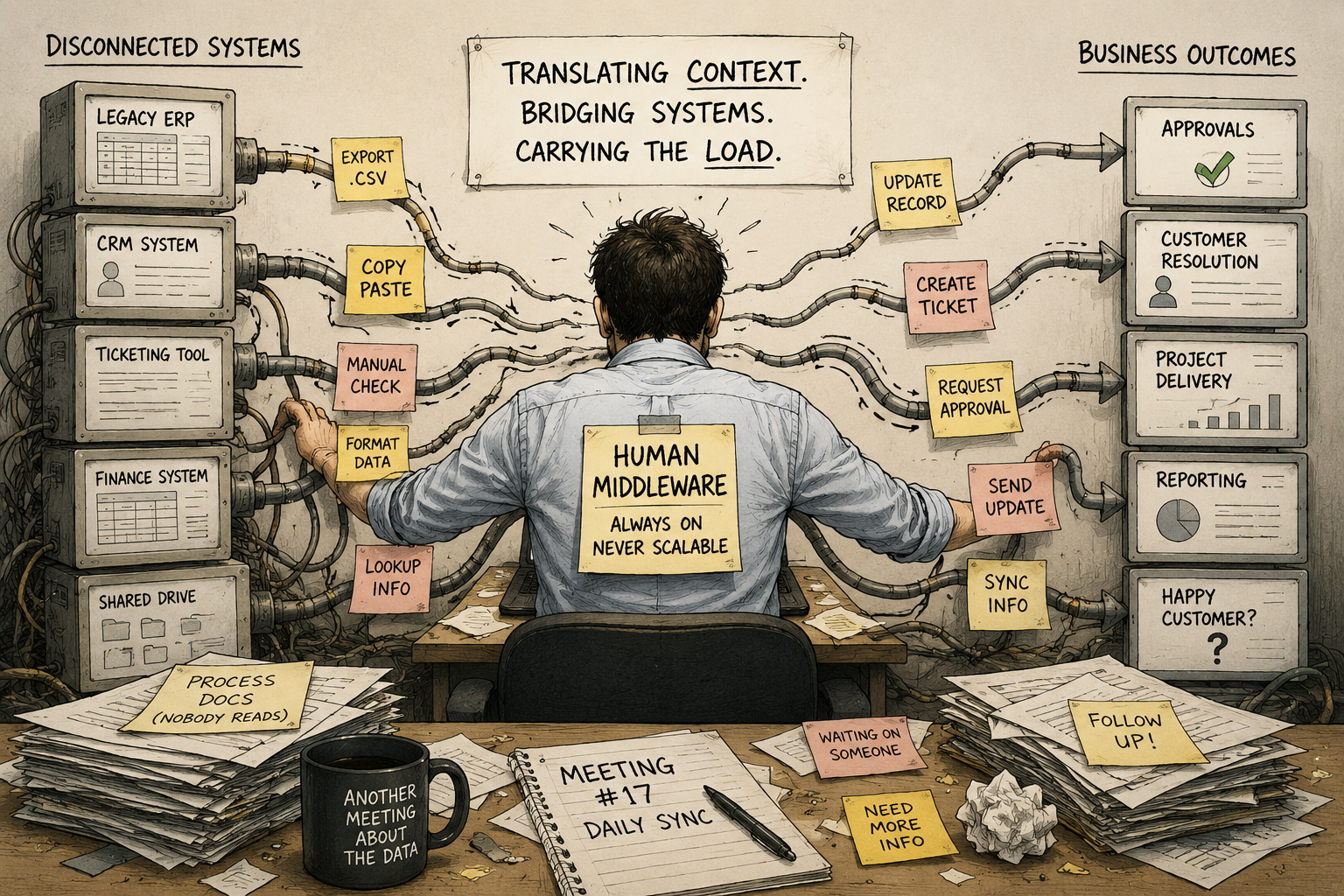
Humans became the translation layer.
Not because that was the best operating model, but because software needed the world structured in very specific ways to function reliably.
Dropdowns. Mandatory fields. Approval chains. Weekly status meetings. Naming conventions. Spreadsheet reconciliations. Three systems all storing slightly different versions of the same customer.
The software required the process to survive.
For years we treated this complexity as professionalism.
But a lot of it was really just operational scaffolding wrapped around rigid technology.
Take something simple like changing a customer address.
In theory, this should take seconds.
In reality, someone updates CRM. Billing has its own record. Logistics syncs overnight. Customer service still sees the old information. Finance exports another version on Friday. By Monday morning, three departments are arguing over which dataset is “correct”.
Then leadership wonders why basic operational changes feel slow and strangely exhausting.
The problem was rarely that people were incompetent.
The problem was that enterprise software only worked well when reality behaved in structured, predictable ways.
Humans do not behave that way.
Customers change their minds halfway through processes. Information arrives incomplete. Teams interpret rules differently. Departments optimise around conflicting incentives. Exceptions appear constantly.
Real work is messy.
So organisations compensated.
Whenever systems struggled with ambiguity, process filled the gap. More governance. More coordination. More reporting. More people sitting between systems and departments manually translating context because the technology itself could not tolerate uncertainty.
Eventually entire layers of enterprise operations formed around managing friction created by the systems themselves.
The strange part is that many organisations now mistake this coordination overhead for operational maturity.
If something requires seven approvals, four steering committees and a weekly status deck, it must be important.
That is why AI feels different.
Not because it suddenly makes organisations intelligent, but because modern models can tolerate messiness that older software could not.
Traditional systems expected humans to speak the language of the machine. Structured inputs. Defined workflows. Exact syntax.
AI flips that relationship around.
Increasingly, systems attempt to interpret the way humans naturally communicate, vague context, implied meaning, contradictions, and all.
That sounds subtle, but it has fairly profound implications.
Because if systems become better at handling ambiguity, organisations may no longer need as much operational ceremony simply to keep information flowing.
Some process genuinely disappears because the original technical constraint disappears with it.
But software limitations are only half the story.
Some enterprise complexity exists because organisations do not trust humans at scale.
Approval chains are often accountability structures as much as operational necessity. Governance processes distribute risk. Reporting rituals create defensibility. Complexity protects ownership boundaries and management layers.
Which means even if AI reduces coordination overhead technically, many organisations will still preserve parts of that complexity culturally and politically.
And AI introduces its own tension.
Traditional enterprise systems succeeded because they were predictable.
AI succeeds because it is adaptive.
Those are not naturally compatible philosophies.
A deterministic workflow can be audited line by line. Probabilistic systems behave more like people, flexible, useful and occasionally strange.
So replacing rigid process with AI interpretation is not automatically simpler. Sometimes it just shifts where uncertainty lives.
Which is why borrowed IQ is not borrowed wisdom.
The organisations that benefit most from AI probably will not be the ones that automate the fastest.
They will be the ones capable of recognising which parts of their complexity were genuinely valuable, and which parts only existed because software could not previously handle the messiness of human reality.
Because for the first time, enterprise systems are starting to adapt to humans rather than forcing humans to adapt to the system.
Keep Exploring
Keep pulling this thread with The Brutal Truth About Agentic AI and Integration Debt, or for a different angle on the same hype cycle, try Views on the SaaSpocalypse: Lessons from a Sheep Called Dolly.