How to Deliver Salesforce Outcomes with Agentic AI
Introduction
Salesforce delivery has entered a new era.
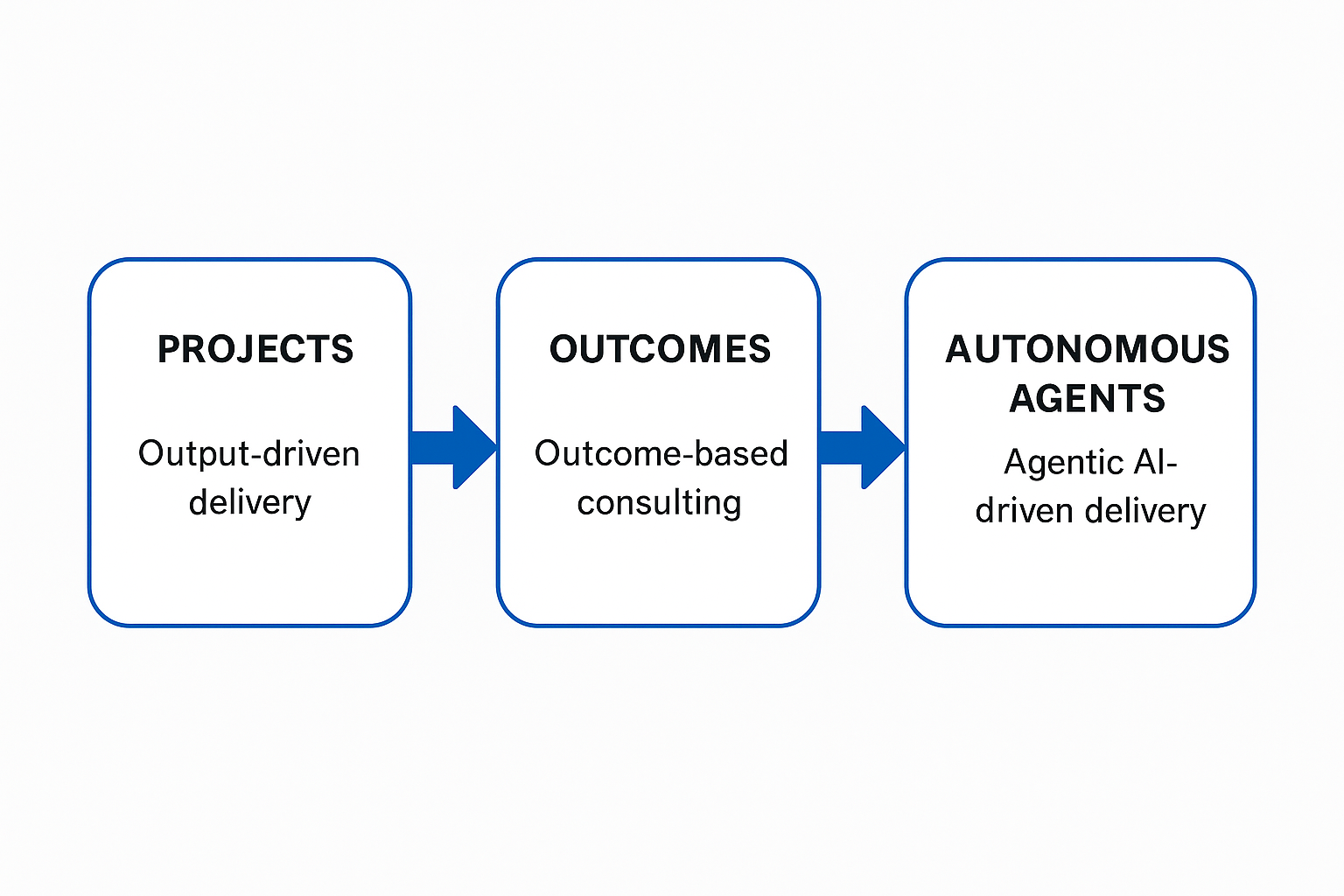
Not through a flashy demo, but through a structural shift: teams are now being measured by outcomes, not outputs.
The catalyst is agentic AI — systems that can plan, act, and coordinate toward a goal. And Salesforce’s launch of Agentforce Vibes has made that shift impossible to ignore.
In this post:
- Why outcome-based consulting is now the default.
- How agentic AI is changing delivery models.
- What a modern Salesforce squad really looks like.
- A practical playbook for delivering and contracting for outcomes.
- The risks and how to manage them.
Why Outcome-Based Consulting Is No Longer Optional
Consulting once rewarded effort: hours, deliverables, documentation. That model breaks when AI compresses timelines.
Clients are no longer paying for presence, they’re paying for proof.
Harvard Business Review recently noted that generative AI is forcing firms to abandon pyramid models and move toward outcome-driven engagements (Duncan, Anderson & Saviano, HBR 2025).
McKinsey echoes the same point: shared-value contracts are replacing time-and-materials as the dominant commercial model (McKinsey, 2025).
Enterprise RFPs are already reflecting this shift. Success is measured in tangible outcomes such as reduced service cost or increased customer conversion. not task completion.
Agentforce Vibes and the rise of agentic AI
In On 1 October 2025, Salesforce launched Agentforce Vibes, described by TechCrunch as a “vibe-coding” platform — one that lets developers describe functionality in natural language (i.e., specify what they want through plain-English prompts) and have an AI agent build it automatically (TechCrunch, Oct 2025).
This is not a lab experiment. It’s production software for enterprise use.
Why it matters
- It collapses development cycles.
Vibe Codey, the agent behind Vibes, reads existing orgs, applies coding standards, and assembles new functionality in hours. The feedback loop between business hypothesis and measurable outcome has never been shorter. - Governance is built in.
Security, compliance, and observability are native — not bolted on. - It enables outcome-based consulting at scale.
With friction removed from delivery, both client and partner can focus on value creation and shared savings.
Agentforce Vibes is proof that agentic AI has moved from concept to capability.
What a modern Salesforce squad looks like
| Timeframe | Composition | Focus | Team dynamic |
|---|---|---|---|
| Five years ago | PM, Architect, Consultant, Developer, QA | Features, milestones, UAT | Sequential hand-offs |
| Today | Platform Owner, Salesforce Engineer(s), Quality Engineer, Architect, DevOps, Data/AI Specialist | Outcome metrics, reliability, CI/CD | Cross-functional, shared accountability |
| Next 12 months | Add AI Agent Engineer, Prompt/Orchestration Lead, Agent Governance Analyst | Live outcome telemetry, agent reliability | Human + agent pairs in squads |
| 2–3 years ahead | Capability-based squads with embedded agents | Outcome performance bands (e.g. cost per case targets) | Continuous learning between agents and humans |
The playbook: deliver and contract for outcomes
1. Define the outcome
Select one clear North-Star metric — for example, cost per resolved case or incremental revenue per lead. Add two supporting indicators such as First Contact Resolution (FCR), Average Handle Time (AHT), or CSAT. Agree how the metric is calculated and measured.
2. Baseline quickly
Run two to four weeks of instrumented discovery. Capture logs, agent outputs, and process metrics. Build a KPI tree to understand drivers.
3. Structure the contract
- Fixed fee for foundations: platform, data, governance.
- Variable incentive tied to verified improvement.
- Clawback if quality drops.
- Transparent audit of agent activity and lineage.
4. Deliver in value iterations
Review results every fortnight. Keep what moves the metric, drop what doesn’t.
5. Use agentic AI where it fits
Agents handle routine actions; retrieval-augmented generation (RAG) supports context. Automate testing and monitoring. Keep humans for judgement calls.
6. Measure, settle, learn
Pay against verified deltas. Re-baseline quarterly. Pause incentives if attribution becomes unclear.
Example: service-efficiency programme
| Element | Example |
|---|---|
| Goal | Reduce cost per service resolution by 10 percent in six months |
| Primary metric | Cost per resolved case |
| Supporting metrics | FCR, AHT, CSAT stability |
| Levers | Agent deflection, agent-human handoff, workflow tuning |
| Contract | Base platform + incentive pool with shared upside/downside |
| Cadence | Monthly reviews, quarterly true-up |
| Agent use | Agentforce Vibes builds and tests flows; agents monitor outcomes |
| Ownership | Client owns assets and telemetry; partner keeps anonymised patterns |
2025 Reality Check
- Agentforce Vibes delivers autonomous feature creation directly inside Salesforce (TechCrunch, 2025).
- Agentic AI is moving from theory to execution (McKinsey, 2025).
- Enterprise clients now expect outcome clauses in contracts (HBR, 2025).
- Multi-agent ecosystems are emerging across Service, Data, and Marketing Cloud (Salesforce Newsroom, 2025).
- AI-augmented teams outperform traditional ones on speed and quality (ArXiv Labs, 2024).
Risks to manage
- Agent drift. Monitor behaviour, version control, and rollback paths.
- Attribution blur. Use control groups when multiple agents act.
- Over-automation. Keep clear human checkpoints.
- Governance and security. Treat agents as users with permissions and logs.
- Contract bloat. Simplicity wins — three metrics maximum.
What to do next
- Start small with one metric and one agentic use case.
- Run a 90-day pilot and measure results.
- Re-contract for value and share gains.
The tools are here. The shift is overdue.
Full citations
- TechCrunch (1 Oct 2025). Salesforce launches enterprise vibe-coding product, Agentforce Vibes. https://techcrunch.com/2025/10/01/salesforce-launches-enterprise-vibe-coding-product-agentforce-vibes/
- Salesforce Developer Blog (1 Oct 2025). Unleash Your Innovation with Agentforce Vibes. https://developer.salesforce.com/blogs/2025/10/unleash-your-innovation-with-agentforce-vibes-vibe-coding-for-the-enterprise
- Harvard Business Review (Sep 2025). AI Is Changing the Structure of Consulting Firms. https://hbr.org/2025/09/ai-is-changing-the-structure-of-consulting-firms
- Harvard Business Review (Apr 2025). How People Are Really Using Gen AI in 2025. https://hbr.org/2025/04/how-people-are-really-using-gen-ai-in-2025
- McKinsey & Company (Sep 2025). The Agentic Organization: Contours of the Next Paradigm for the AI Era. https://www.mckinsey.com/capabilities/people-and-organizational-performance/our-insights/the-agentic-organization-contours-of-the-next-paradigm-for-the-ai-era
- McKinsey & Company (Sep 2025). One Year of Agentic AI: Six Lessons from the People Doing the Work. https://www.mckinsey.com/capabilities/quantumblack/our-insights/one-year-of-agentic-ai-six-lessons-from-the-people-doing-the-work
- Reuters (17 Dec 2024). Salesforce Closes 1,000 Paid Agentforce Deals, Looks to Robot Future. https://www.reuters.com/technology/artificial-intelligence/salesforce-closes-1000-paid-agentforce-deals-looks-robot-future-2024-12-17/