
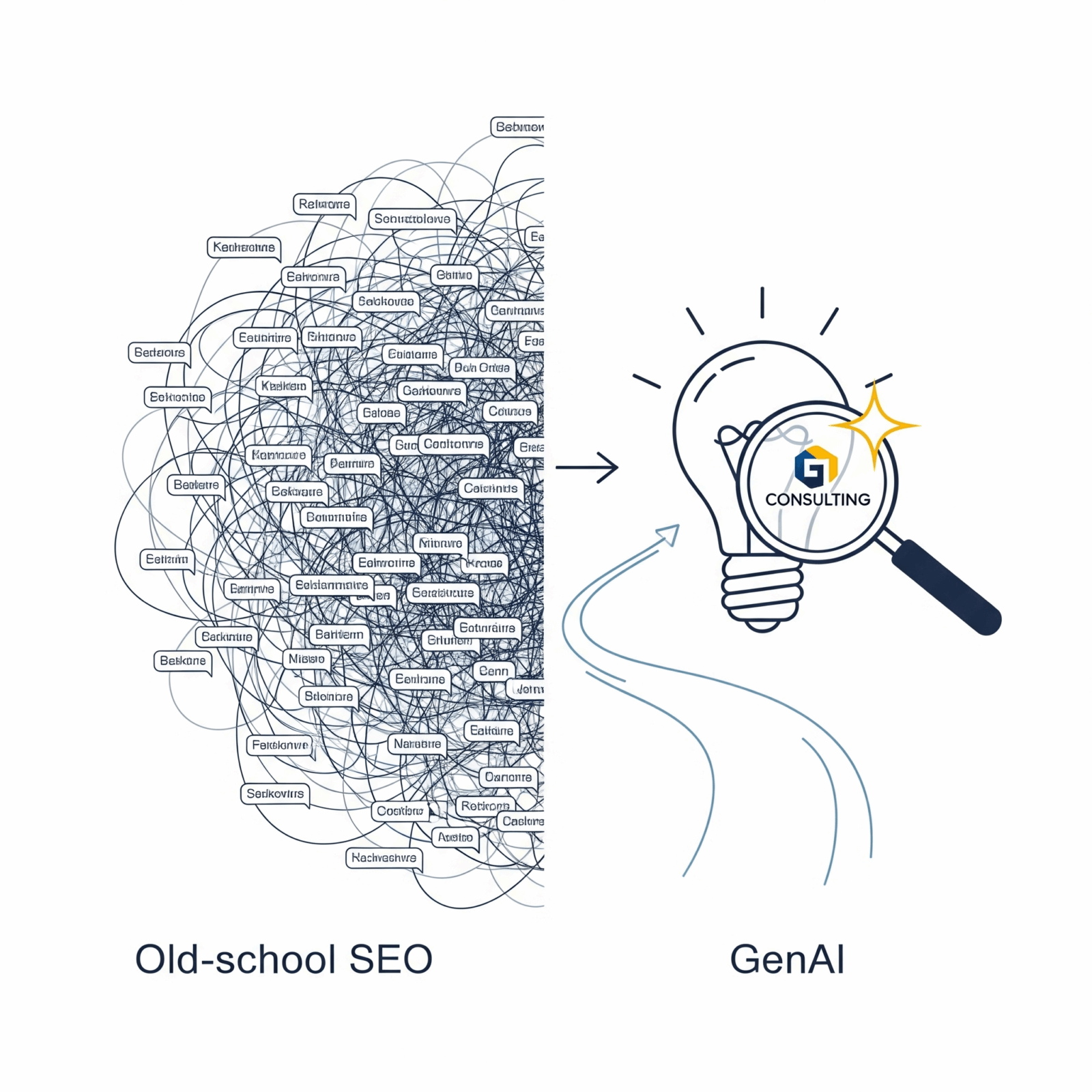
From SEO to GenAI: Win in the New Search Era.
For years, the growth playbook for a small business was simple:
- Build a sharp website.
- Optimise every page for SEO.
- Buy a few ads.
- Cross your fingers and hope Google sent traffic your way.
But the world has shifted. People aren’t just typing into search bars anymore. They’re asking questions into GenAI tools like ChatGPT, Claude, Gemini and Perplexity. And when a potential client asks:
“What are the best Salesforce partners in Australia for Data Cloud?”
“Who can help me with Workato orchestration?”
“Do I need a GSI or an RSI for my Salesforce project?”
…the answers are increasingly shaped by GenAI search visibility, not just old-school SEO.
Why This Matters for Small Businesses
Competing with global giants in SEO is a slog. They’ve got whole teams churning out keyword-optimised content and endless budgets to buy backlinks.
GenAI levels the playing field. It rewards:
- Clarity over keyword stuffing.
- Original thought over content mills.
- Useful answers to specific questions, even from small sites.
For example, if you’re a small consultancy firm, a three-paragraph blog post that directly answers “How to integrate Workato with Salesforce Data Cloud in under 2 weeks” is more valuable to GenAI than a 20-page PDF that dances around the topic.
How to Check if You’re Showing Up
Here’s how small businesses can sense-check their GenAI visibility:
- Ask AI directly. Go to ChatGPT, Claude, Gemini or Perplexity. Ask the exact questions your prospects ask. See if your content is included.
- Use Perplexity. It almost always cites sources. If your site pops up, you’re in the game.
- Dig into GA4. Look for spikes in “Direct” or “Unassigned” traffic to niche blog posts. If they line up with questions you’ve tested in AI, that’s a strong clue.
- Track backlinks as a by-product. GenAI itself doesn’t need backlinks, but once your ideas surface, people often share or cite them. Those links are a lagging indicator, not the driver.
A Tangible Scenario
Imagine you’re a 20-person Salesforce RSI in Sydney.
A prospect asks ChatGPT:
“Should I hire a GSI or an RSI for my Salesforce integration?”
The model pulls your blog where you’ve written a clear, side-by-side comparison. The buyer sees your thinking without even clicking your homepage. And because your explanation is direct and useful, it outshines the vague corporate jargon of bigger players.
That single blog post could be the moment you move from invisible to on the shortlist, because GenAI doesn’t just answer the question, it makes you part of the buyer’s discovery journey.
A Playbook for Small Businesses
If you want to position your firm for growth in this new search era:
- Write for questions, not keywords. Take the exact wording your clients use and answer it plainly.
- Go deep on niche expertise. Forget “Salesforce Consulting.” Own the micro-questions like “Manufacturing ROI from MuleSoft Process Mining” or “How RSIs deliver faster than GSIs in CPG.”
- Make content share-worthy. Create posts, frameworks, or checklists that people will want to reference in LinkedIn posts or industry Slack channels. Shares are the new backlinks.
- Check monthly. Run your top 5 client questions through AI tools. Are you showing up? If not, refine and try again.
A Humble Admission & A Personal Favour
Despite once working in digital media and selling websites and optimisation, my own blog (this one you’re reading now) has exactly zero inbound links.
And yet… it’s getting organic traffic. Some of that comes from traditional SEO (mostly people stumbling on my review of Joe Aston’s book), but more and more, posts are being surfaced in GenAI answers.
It’s proof that the ideas themselves matter more than the tricks of the trade.
f you do find something useful on my blog, I’d be grateful if you shared it or linked to it. Not just for SEO points (though inbound links do help), but as a personal favour. The more these ideas travel, the more they’ll surface where people are actually looking: inside AI answers.
Because in the GenAI age, the best optimisation strategy is still the simplest one: write for humans first.