
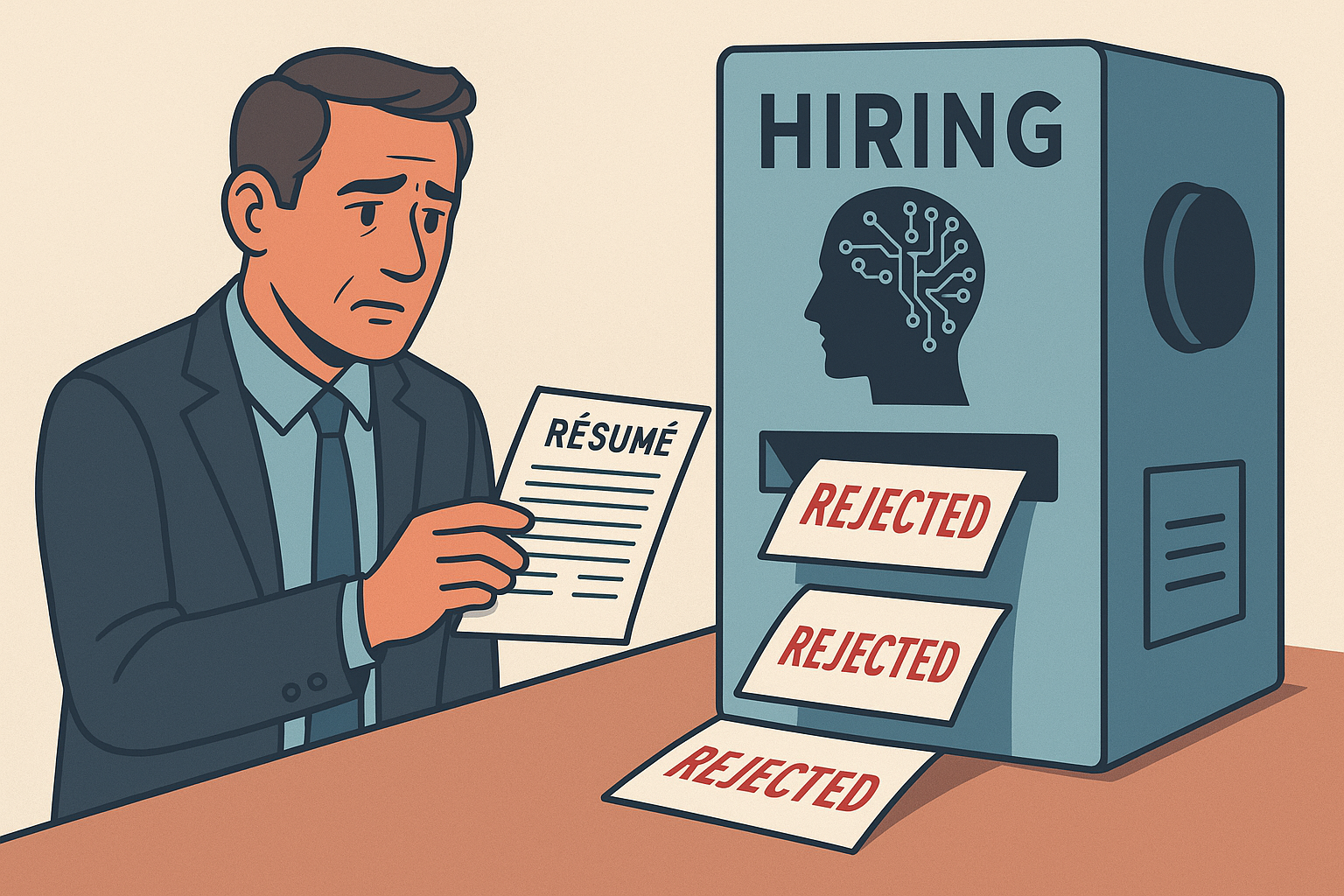
Filtered Out: How AI Decides You’re Too Old for the Job
We talk a lot about bias in hiring. Gender, race, and background. But there’s one form of discrimination every single person will eventually face: ageism.
And now it’s being automated.
The Workday Lawsuit
In the U.S., Workday is facing a landmark lawsuit. Plaintiffs allege its AI recruiting tools act as a gatekeeper, filtering out qualified candidates over 40 before a human ever looks at their CV.
The case, Mobley v. Workday, claims the algorithms aren’t coded to reject older applicants outright, but they rely on proxies: graduation dates, lengthy career histories, or even the style of language in a résumé. Algorithms lean on these signals because they correlate with what the system has been trained to see as “successful” candidates; recent skills, shorter résumés, or linear career paths. In reality, this just encodes a preference for younger applicants.
The scale is staggering. Court documents revealed that around 1.1 billion applications were rejected through Workday’s software during the relevant period. Plaintiffs argue the collective could include “hundreds of millions” of candidates. The lead plaintiff, Derek Mobley, a Black man over 40, says he applied for more than 100 jobs at companies using Workday and was rejected every time. His case also shows how bias can compound, age and race discrimination intersect, creating even steeper barriers when AI amplifies past prejudices.
In May 2025, a U.S. judge allowed the case to move forward as a collective action. That’s a clear signal that systemic bias in algorithmic hiring deserves serious scrutiny.
Why AI Learns Bias
The reality is that AI doesn’t invent prejudice, it scales it.
Hiring algorithms are trained on past data. If organisations historically preferred younger candidates, the machine learns that pattern and bakes it into its definition of an “ideal” hire. What was once a human bias becomes an automated rule, applied millions of times with no space for nuance or second chances.
This isn’t theoretical. In 2018, Amazon scrapped an AI recruiting tool after it was found to be biased against women. The system had learned from a decade of male-dominated résumés, so it downgraded applications that included words like “women’s” or came from all-female colleges. Bias in, bias out.
The Australian Picture
This isn’t just a U.S. problem.
Workday is used by some of Australia’s largest employers including banks, universities, telcos, health providers, and government agencies. The exact modules each uses aren’t public, but if AI recruiting is switched on, the same risks exist here.
The Australian Human Rights Commission has already flagged the issue. Its 2021 report found that 27% of employers considered people in their early 50s “old,” and almost half of employers (49%) admitted they were reluctant to hire someone over 50.
Yet older workers remain a critical part of the economy. In 2023, the Australian Bureau of Statistics reported a 67.6% labour force participation rate for people aged 55–64, and 15.4% for those 65 and older. Far from stepping back, older Australians are staying in work longer and contributing significantly.
And it doesn’t stop at hiring. Older employees are already disproportionately impacted in restructures and retrenchments, as experience (and the salary that comes with it) is traded out for short-term cost savings. A 2022 Grattan Institute survey found 12% of Australian workers over 50 had been retrenched in the previous five years, compared to 8% of those under 50. Add algorithmic hiring bias on top, and the message is clear: you’re more expendable at both the door and the desk.
The Inevitable Irony
Every recruiter, hiring manager, and executive applauding AI “efficiency” will eventually face the same system. Ageism isn’t an if, it’s a when. The bias people ignore now is the one waiting for them down the line.
The Business Case Against Ageism
This isn’t just a moral failure, it’s a commercial one.
Cutting out experienced candidates means undervaluing:
- Judgment, built over decades of decisions
- Resilience, proven through downturns, restructures, and crises
- Perspective, the ability to see patterns others miss
These are the qualities that help companies survive disruption. Yet they’re exactly what’s being filtered out before anyone even says hello.
The U.S. Equal Employment Opportunity Commission estimates that age discrimination costs the economy billions of dollars each year in lost productivity and innovation. The business case is as clear as the moral one.
What Needs to Change
Fixing this doesn’t have to be complicated. Companies need to:
- Audit AI systems to identify and correct bias in screening
- Demand transparency from vendors on how candidates are ranked or rejected
- Shift to skills-based hiring, not proxies like graduation year
- Keep a human in the loop to review applications flagged by the algorithm
- Remove age signals like dates from résumés before screening
Regulation is coming too. New York already requires audits of AI hiring tools, and Europe is moving ahead with the AI Act. Australia will need to follow, or risk leaving both employers and candidates exposed.
AI is marketed as a way to reduce bias and increase efficiency, but in practice it often encodes the same old prejudice in lines of code. The difference is that now, it’s harder to spot and easier to justify.
We All Get Older
Ageism is the one bias that catches everyone eventually.
If organisations don’t act now, if they keep outsourcing judgment to algorithms and hiding behind restructures, they’ll find that the systems they applauded have turned against them too.
We all get older. We all deserve better.
Keep Exploring
On a related note, You Are More Than Your Job Title looks at identity and career from a different angle, and From WFH to WTF digs into how work itself is changing.