
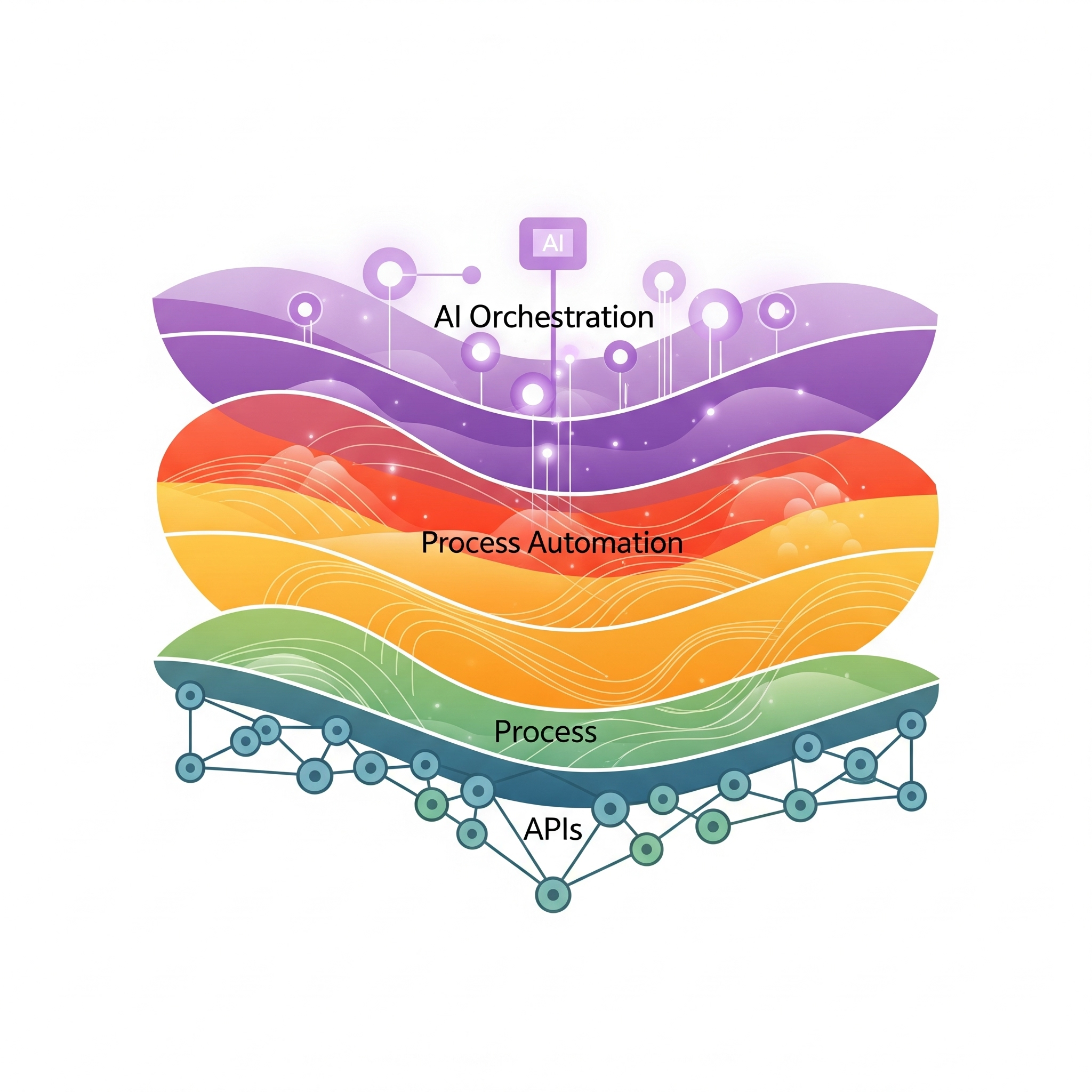
How to Scale AI Without Starting From Scratch: Lessons From APIs
We’re in a gold rush moment for AI. Everyone’s racing to plug Large Language Models (LLMs) into their business somewhere, anywhere, hoping it’ll save time, reduce costs, or at least help draft a half-decent email.
But if we’re honest, many of these efforts look a lot like the early days of APIs… disjointed, duplicative, and duct-taped together. Back then, MuleSoft’s layered architecture taught us to build with structure. Today, as we rush to operationalise AI, that same lesson needs to be heard again:
Don’t just wire an LLM into a chatbot and call it a strategy. Architect for scale, or prepare for chaos.
🧱 What APIs Got Right
When APIs became the hero of modern integration, platforms like MuleSoft championed a three-tier model:
- System Layer connected to source systems like SAP, Oracle, or Salesforce
- Process Layer applied business logic and allowed reuse of rules across experiences
- Experience Layer tailored the output for specific use – mobile, web, internal tools
This wasn’t just tech theatre; it was a mindset shift. Instead of building everything bespoke and brittle, we started designing for reuse.
It was efficient. It was safe. It was governed. Most importantly, it aligned to business outcomes, not just IT whims.
🤖 Why AI Needs the Same Architecture Mindset
Fast forward to today’s AI frenzy. Everyone’s got a model. Everyone’s got a use case. But few have a plan.
The result?
- Redundant prompts, bloated costs
- Fragmented experiences across channels
- Data exposure and audit nightmares
- Zero ability to scale without chaos
It’s the same mess we saw before APIs… just faster and more expensive.
🧠 The AI Layered Model: Borrowing From the API Playbook
| Layer | AI Orchestration Role | Analogy |
|---|---|---|
| Experience Layer | Delivers tailored AI outputs in different interfaces | Like telling the same story differently to your board, your team, or your customers |
| Process Layer | Manages prompt chains, business logic, and model routing | Like a conductor coordinating instruments in an orchestra |
| System Layer | Connects to vector stores, databases, and external data | Like a translator that knows how to speak SAP, Salesforce, or your data warehouse |
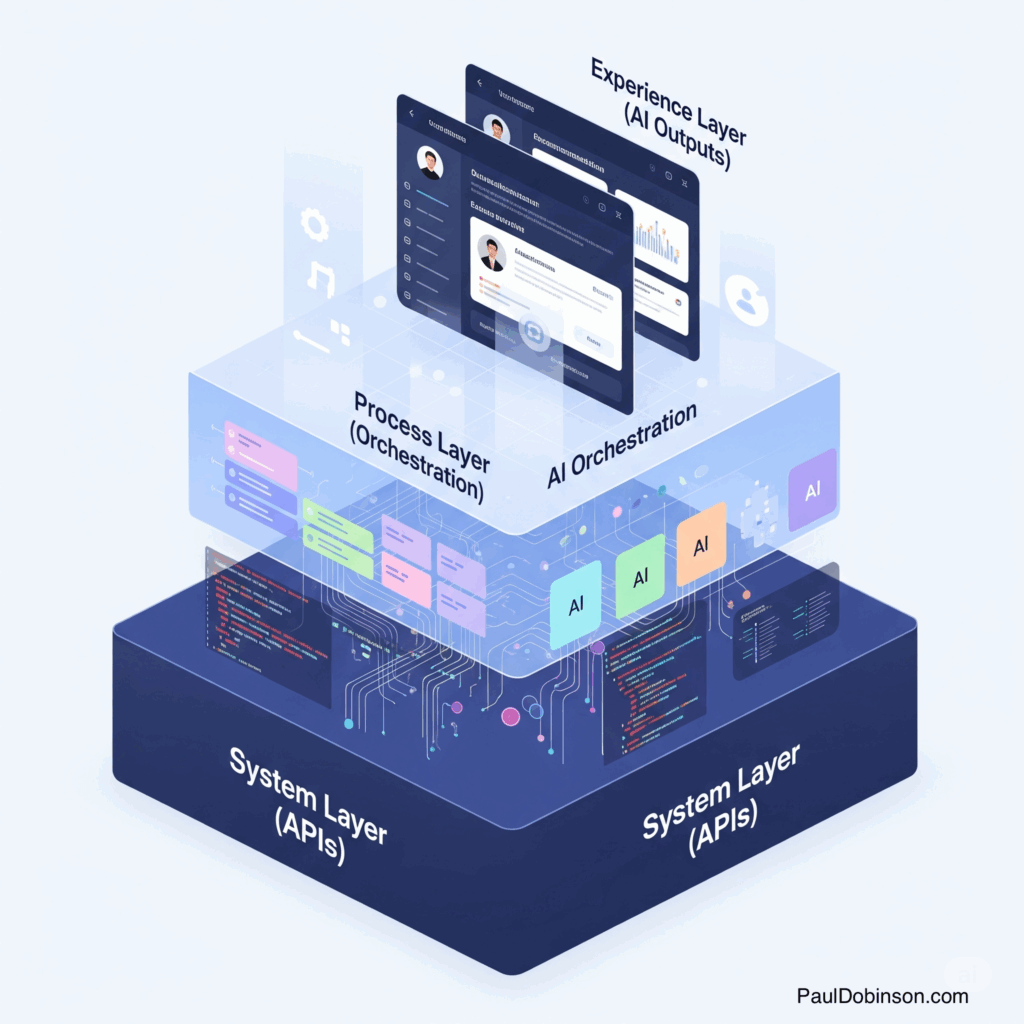
This isn’t just cleaner. It’s smarter. It avoids the trap of rebuilding logic or prompts for every use case, and it gives you something precious in AI: control.
💼 Why Business Leaders Should Care
This isn’t just a wiring diagram for backend teams. It’s about:
- Avoiding cost blowouts
- Staying compliant
- Delivering consistent customer and employee experiences
- Making AI explainable, auditable, and reusable
⚔️ The Vendor Parade
| Vendor | What they’re doing |
|---|---|
| Salesforce | Agentforce + Data Cloud – AI inside your CRM. |
| Microsoft | Copilot embedded across the M365 suite. |
| ServiceNow | AI driving outcomes in regulated workflows. |
| UiPath | From RPA to AI-driven task orchestration. |
| AWS / GCP / Azure | The raw powerhouses… but bring your own architecture. |
Each offers part of the picture. None offer a silver bullet.
Before you commit fully to one approach, make sure your foundation gives you the flexibility to change direction later.
🔄 Who’s Orchestrating the Orchestration?
While most AI headlines focus on what the models can do, the real battleground is orchestration.
That middle layer – where data gets retrieved, prompts composed, models selected, and results routed – is where chaos either reigns or gets tamed. It’s also where middleware tools quietly make everything just work.
The best orchestration platforms are:
- Model-agnostic
- Data-aware
- Secure by design
- Built for change, not just first wins
They’re not the flashiest part of your AI story, but they’re often the most important. One major SaaS provider recently had to quietly pull back an internal AI summarisation tool – not because it didn’t work, but because they couldn’t control what data it accessed. That’s the price of skipping orchestration.
🌐 What’s Next: Layers Will Evolve
Orchestration today is just the start. Coming soon:
- Semantic layers
- Knowledge graphs
- Specialised agents that collaborate across departments and domains
None of it matters if the foundations aren’t there. Structure first, smarts second.
🧭 Final Word
Don’t just build AI. Architect it.
That’s how you avoid becoming the business with 17 copilots, no audit trail, and a legal team asking if your chatbot just leaked payroll data.
👇 Your Turn
How’s your AI layered up? Share your story, or your scars.