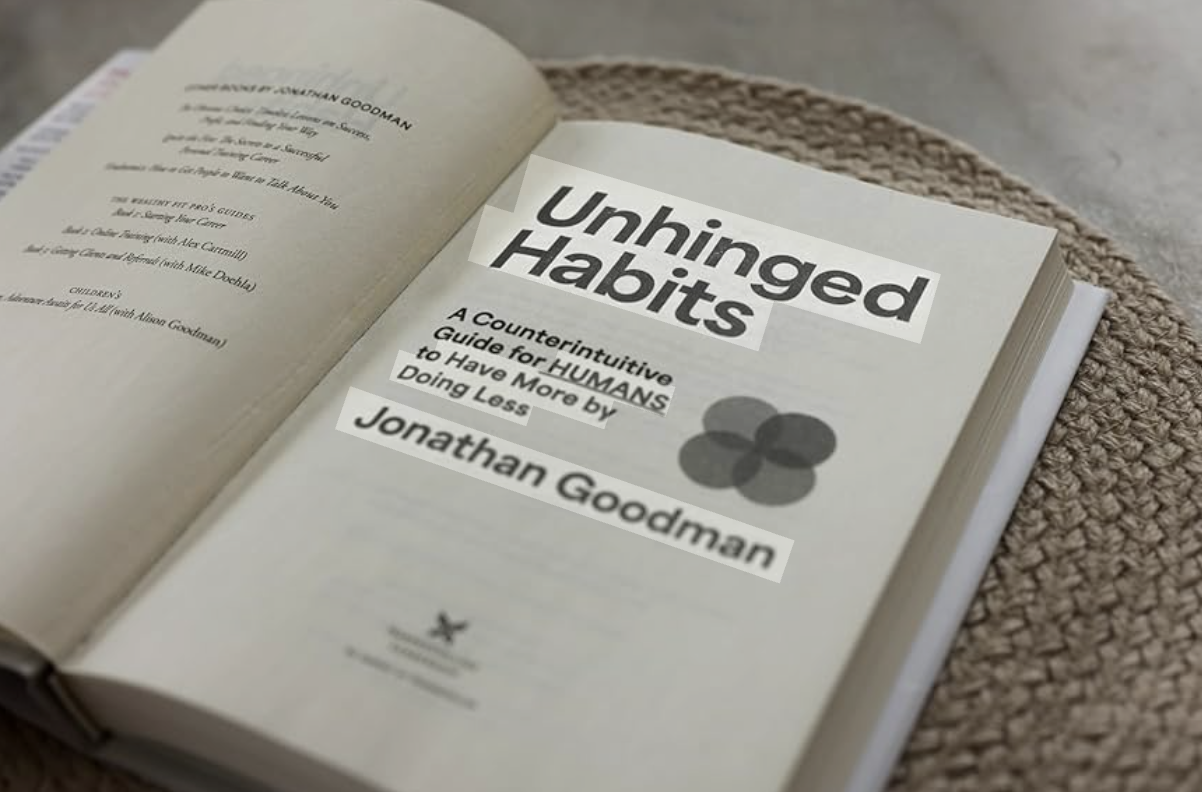
Unhinged Habits: Fewer Commitments, Clearer Priorities
A review of Jonathan Goodman’s counterintuitive take on focus, balance and what really matters
We spend a lot of time trying to optimise our lives.
Better routines. Better habits. Better balance.
In Unhinged Habits, Jonathan Goodman argues that this obsession with constant balance might actually be part of the problem.
Instead of trying to improve everything at once, he suggests life works better in cycles. Periods of intense focus on something meaningful, followed by periods of exploration, recovery, or simply doing less.
One example he uses is an “8:4” rhythm. Eight months focused on a priority, followed by four months where you ease off or shift gears. It’s not meant as a rigid rule, more a way of illustrating a broader idea.
Life rarely moves in straight lines.
Focus tends to come in waves.
Cycles are normal in sport
This idea felt familiar to me.
I studied sport psychology and briefly worked as a personal trainer. In sport, no serious coach expects an athlete to train at peak intensity all year round. Training programmes move through cycles. Athletes build, push, peak, recover, and then build again.
The concept is known as periodisation, and it has been part of training science for decades.
In many ways, Unhinged Habits feels like those same principles applied to life.
Focus deeply for a period. Then step back, recover, explore, and reset before the next push.
Where the analogy becomes harder to apply is when you move from training programmes to real life. In sport there are clear goals, feedback loops, and often an off-season.
Life tends to be messier than that.
There are mortgages, school runs, and responsibilities that don’t neatly pause while you enter your “exploration phase”.
Still, the underlying idea is interesting.
Reduction beats optimisation
The concept that resonated most with me was reduction.
Many habit books focus on what to add. Another routine. Another habit. Another system designed to optimise your life.
Goodman asks a simpler question: what could you remove?
Most people aren’t short of effort. They’re short of focus.
Too many commitments. Too many inputs. Too many things that seemed like a good idea at the time.
Cutting things out often creates more progress than adding another productivity system.
You see this in work as well. Teams rarely struggle because people aren’t working hard enough. They struggle because they’re trying to pursue too many priorities at once.
Focus sometimes requires imbalance
Another idea I liked was the acceptance that progress often requires temporary imbalance.
Trying to keep every area of life perfectly balanced at all times can mean nothing really moves forward.
Sometimes something needs to take priority for a period. A project at work. A creative pursuit. A health goal.
That doesn’t mean neglecting everything else. But it does mean accepting that some areas may simply be good enough for a while rather than perfect.
We often feel pressure to optimise everything simultaneously. Goodman pushes back on that idea. If something truly matters for a period, it’s okay if other areas are simply ticking along.
Perfection across every part of life isn’t realistic.
Friendship and family
The part of the book I appreciated most was the discussion around relationships.
As life becomes busier, friendships often drift. Not because people stop caring, but because time quietly fills with other things.
Goodman argues that a few deep friendships matter far more than maintaining a long list of casual connections. The friendships that tend to last are the ones where people genuinely enjoy each other’s company and show up when things get difficult.
Those relationships need deliberate investment.
The same applies to family.
Once you have children, time stops being theoretical. The years move quickly and you don’t get them back. A lot of productivity advice treats life like an optimisation problem.
Sometimes the real discipline is simply deciding what matters most.
Where I wasn’t entirely convinced
There were parts of the book where I found myself pushing back.
One was the parenting philosophy. Goodman leans toward a fairly relaxed, exploration-heavy approach where children are given a lot of freedom and structure is lighter.
My instinct is slightly different.
Kids, like athletes, tend to thrive on structure and boundaries. Predictable routines and clear expectations create psychological safety.
In sport, creativity and exploration still sit inside clear structures. Elite performers operate within well-defined boundaries.
Goodman does acknowledge the need for balance between rules and freedom, but I’m not sure children necessarily experience that balance in the reflective way adults might.
So would I recommend the book?
Yes.
There’s enough in there that most readers will take something useful from it. Not every idea will resonate with everyone, but that’s probably the point.
A good sign for me is when I find myself quoting parts of a book in everyday conversation. I caught myself sharing some of the ideas around focus, priorities and family time with my wife.
That’s usually a good indicator that something has stuck.
I’m not about to structure my life around an 8:4 model.
But the reminders were useful.
Fewer unnecessary commitments.
More intentional friendships.
Focused effort on things that matter.
And putting family first while the time is still there.
Life is too short to spend most of it anxious about everything we’re not optimising.